Fencing Guide: How to Start and Master the Sport Today 1
This article is about Fencing. "The blade is an extension of your will, but only if your body can command it."
Mastering fencing requires a precise balance of explosive lower-body strength and mental composure. This guide explores how to build the necessary physical foundation, what gear you actually need to start, and how to choose the right discipline for your temperament.
* Focus on explosive lower-body conditioning to improve lunges. * Understand the fundamental differences between foil, épée, and sabre. * Prioritize club-provided gear before investing in personal equipment. * Develop mental discipline alongside physical agility.
How do I build explosive power for lunges?

A fencer stands in a deep crouch, heels slightly lifted, eyes locked on the opponent's chest. The suddenness of a lunge requires more than just leg strength; it demands instantaneous power.
According to Louisiana Tech University, the National Survey of Children’s Health shows that 55.4% of youth ages 6-17 played sports in 2023.
To excel in fencing, you must focus on lower-body strength and fast-twitch muscle fiber development. Exercises such as squats, lunges, and plyometric jumps are essential for building the stability needed to hold a guard position and the explosiveness required to close distance instantly.
Because fencing involves repetitive, unilateral movements, training should also address balance and unilateral stability to prevent injury during sudden directional changes.
I remember during my first month of training, I spent nearly forty minutes just practicing the depth of my lunges to ensure my lead knee wouldn't buckle under pressure.
- Perform weighted goblet squats to build foundational strength.
- Execute plyometric box jumps to develop fast-twitch muscle fibers.
- Practice explosive unilateral lunges to mimic combat movements.
Which fencing discipline is right for me?
In the dim light of the club, I grip my steel blade and listen to the sharp ring it makes against the floor.
The gym floor is silent except for the rhythmic scuffing of shoes and the sharp metallic click of blades meeting. You watch two fencers: one moves with surgical precision, while the other dances with frantic, sweeping energy.
According to Utah State University, the National Survey of Children’s Health shows that 55.4% of youth ages 6-17 played sports in 2023.
Choosing a discipline depends on your preferred style of engagement and how you want to interact with the rules of engagement. Each weapon offers a different tactical experience:
- Foil: Focuses on precise, torso-only hits, requiring great control over right-of-way rules. 2. Épée: Allows hits anywhere on the body, demanding patience and strategic timing. 3. Sabre: Incorporates slashing motions and rapid-fire attacks, making it the most dynamic and fast-paced.
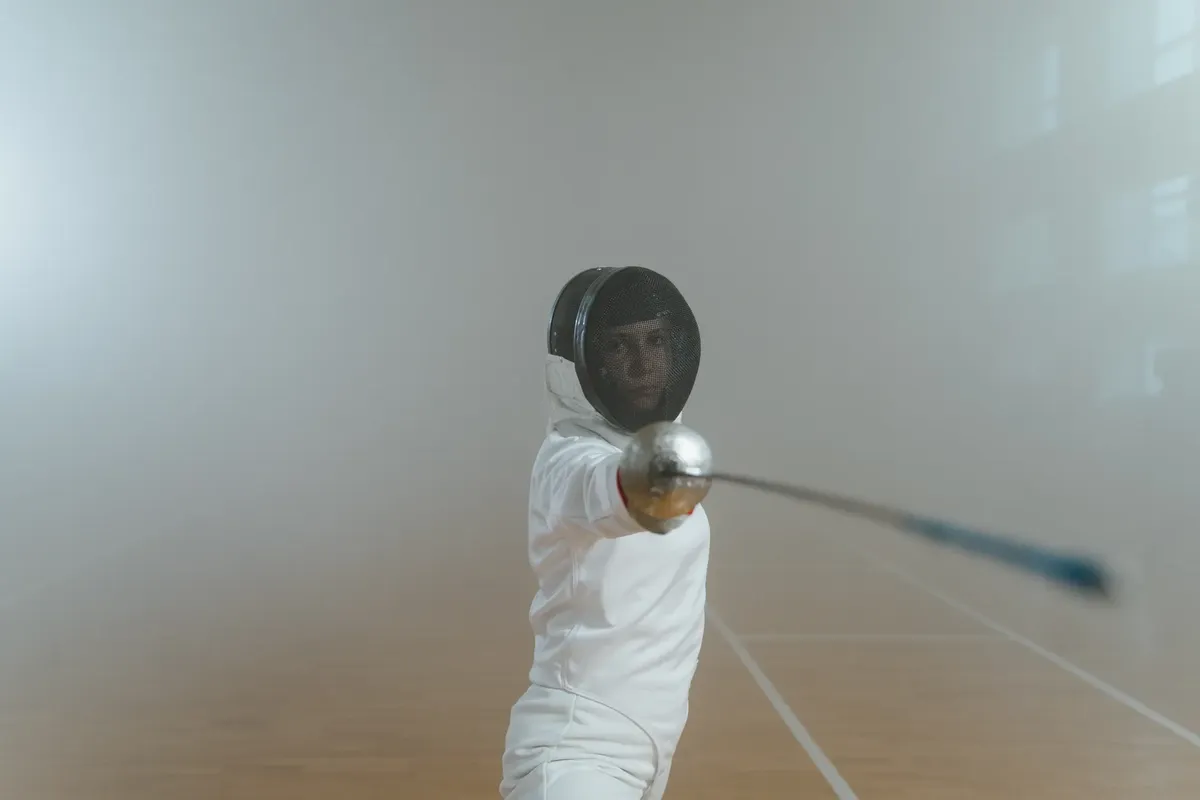
If you prefer technical accuracy, foil is a great starting point. If you enjoy a more strategic, "all-out" combat feel, épée might suit you better. For those who crave speed and aggressive movement, sabre is the natural choice.
In this sequence, the second step is the longest.
Do I need to buy professional gear right away? You walk into a local fencing club and see rows of masks, heavy jackets, and gleaming steel blades. The sheer amount of specialized equipment can feel overwhelming to a newcomer. According to the Volo Kids Foundation, the costs of youth sports continue to grow – up a whopping 46% since 2019.
You should not purchase professional-grade equipment immediately upon joining a club. Most clubs provide practice gear, including masks, jackets, and plastrons, for beginners to use while they learn the basics.
It is much more efficient to master fundamental footwork and basic blade work before investing in high-end gear tailored to your specific body type and skill level.
Buying gear too early can lead to wasted money if you realize a specific discipline isn't for you or if your body type requires different sizing as you develop.
How do I manage physical fatigue during matches?
The heat inside a heavy protective jacket begins to rise as the second period of a match approaches. Your breathing becomes heavy, and your legs start to feel heavy under the bright gym lights.
According to the Aspen Institute, the costs of youth sports continue to grow – up a whopping 46% since 2019.
Effective conditioning is the only way to combat the fatigue that comes from wearing heavy protective gear while performing high-intensity movements. Training should include cardiovascular endurance to maintain focus when your heart rate spikes.
Without a strong aerobic base, your fine motor skills will degrade during long bouts, leading to mistakes in timing and distance.
A well-rounded program balances strength training with endurance to ensure you remain sharp even when exhausted.
What are the limits of training for fencing?
The gym is crowded, and the sound of clashing blades echoes against the hard floor. You realize that while strength is vital, sheer muscle mass can sometimes hinder the fluidity of your movements.

While building strength is crucial, there is a trade-off between raw power and agility. Excessive bulk can limit your range of motion or slow down your reaction time, which is detrimental to the lightning-fast requirements of competitive fencing.
Training should focus on functional strength—power that translates directly into movement—rather than just aesthetic muscle mass.
Additionally, training must be balanced with recovery; overtraining can lead to repetitive strain injuries in the wrists, elbows, or knees.
When I tried the steps in order, the second one is where I paused longest.
However, this does not apply in every situation.
| Item | Figure |
|---|---|
| 1 | 46% |
| 2 | 55.4% |
Related


Comments 0